Govt Unveils a Massive Rs1 Trillion Development Budget
Govt Unveils a Massive Rs1 Trillion Development Budget
ISLAMABAD:
Ahead of the Federal Budget 2026-27, the government on Friday proposed a Rs1 trillion Public Sector Development Programme (PSDP) within a Rs17.5 trillion overall budget, official documents showed.
Under the plan, Rs682.48 billion is allocated to federal ministries, while the National Highway Authority will receive Rs224.51 billion. Key allocations include Rs103.8 billion for water resources, Rs88 billion for power, Rs46 billion for HEC, Rs40.65 billion for railways, and Rs36.31 billion for education.
Rs233.33 billion has been earmarked for provinces and special areas, including AJK, GB, and merged districts. The IT sector is set to receive Rs19.58 billion, health Rs16.06 billion, and interior Rs21.82 billion, while Rs1 billion is reserved for CPEC 2.0 projects.
Overall development spending is projected at Rs3.669 trillion, including Rs2.218 trillion from state-owned enterprises. Planning Minister Ahsan Iqbal said no new development projects will be launched next year except in defence and internal security.
The government has set 4% GDP growth and 8.2% inflation targets for FY2026-27, with services expected to grow 4.2%, industry 4%, and agriculture 3.8%. Investment is targeted at 15% of GDP, with private investment at 10.3%.
Manufacturing growth is set at 5.8%, while IT and communications are projected at 7.7%. Other targets include 2.2% growth in construction and 3.7% in transport.
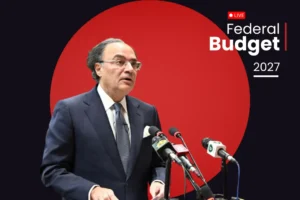
The Rs17.5 trillion budget, to be presented by Finance Minister Muhammad Aurangzeb after a one-week delay, aims to meet IMF conditions while offering limited relief to low-income groups and public sector employees.
Rising global oil prices and regional tensions have added inflationary pressure, with business sentiment weakening and employment declining. The State Bank raised rates by 1% in April, while the FBR has been tasked with a 37% rise in tax collection.
Officials said Pakistan’s large informal economy continues to constrain revenues, while higher taxes risk further squeezing purchasing power. The budget is expected to expand cash transfers for the poorest segments.
About The Author