
UK Firms Adopt Low-Hire Low-Fire Approach Amid Cooling Jobs Market.
Listen2 min
Read aloud by your device’s built-in synthetic voice, not a recording. Needs a browser that can read aloud.
✧ GENERATE BRIEFING
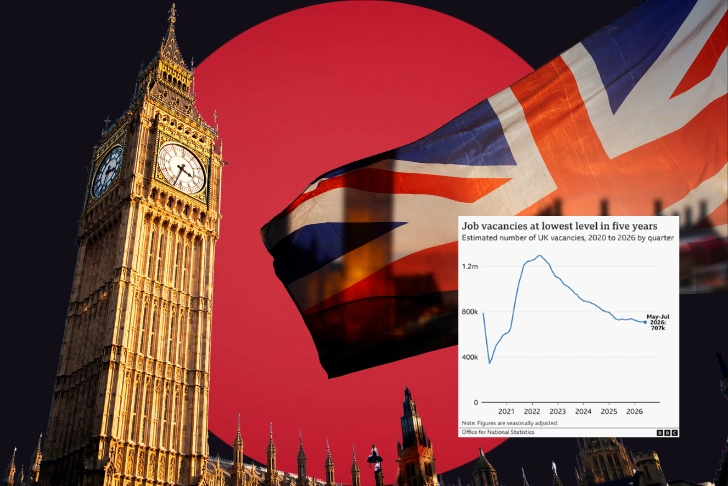
British employers are adopting a "low hire, low fire" posture as labor market momentum cools across the United Kingdom. According to the Chartered Institute of Personnel and Development (CIPD) Summer 2026 Labour Market Outlook, hiring confidence remains near record lows outside the pandemic, with the net employment balance holding at +9 as businesses prioritize staff retention over workforce expansion. Corresponding Office for National Statistics (ONS) data confirms job vacancies fell to 707,000 for May–July 2026 the lowest level since late 2014, excluding the COVID-19 period. While overall unemployment held at 4.9 %, private-sector regular wage growth slowed to 2.8 % annually, its lowest rate in nearly six years. These easing labor pressures provide critical context for the Bank of England as policymakers evaluate inflation dynamics and determine future Monetary Policy Committee (MPC) rate trajectories.
British employers remain reluctant to hire or significantly reduce their workforces, with businesses stuck in a “low-hire, low-fire” pattern, according to a survey by the Chartered Institute of Personnel and Development (CIPD).
The survey showed that hiring confidence remained close to its weakest level outside the COVID-19 pandemic, highlighting continued caution among UK businesses as they assess economic conditions.
The cautious approach comes as the UK labour market shows further signs of losing momentum. Official data released after the survey showed job vacancies falling to their lowest level since 2014, excluding the pandemic period, while employment growth remained weak.
Businesses’ reluctance to expand their workforce suggests that employers are adopting a wait-and-see approach rather than aggressively hiring or cutting jobs.
The softer labour market is being closely watched by the Bank of England, which is assessing whether weakening employment conditions could ease wage and inflation pressures. The central bank has kept interest rates unchanged since December 2025.
Recent data also showed private-sector wage growth slowing to 2.8% annually in the second quarter, its weakest pace since late 2020. The number of vacancies fell to around 707,000, while payrolled employment declined for a sixth consecutive month.
The combination of subdued hiring, falling vacancies and slower private-sector wage growth points to a cooling UK jobs market, although the unemployment rate remained at 4.9%.
The latest figures will add to the Bank of England’s focus on labour-market conditions as it considers the outlook for inflation and future interest-rate policy.