
Pakistan’s Agricultural Recovery Rests on Livestock
Pakistan’s agriculture sector showed signs of recovery during the first quarter of fiscal year 2026, but the rebound remained uneven as strong livestock growth helped offset continued weakness in the crops segment, according to the State Bank of Pakistan’s State of Pakistan’s Economy – Half Yearly Report, July–December FY2026.
The agriculture sector grew 2.9% in Q1 FY2026, compared with 1.0% in the same quarter of FY2025, marking a significant improvement despite the impact of floods and other climatic challenges.
However, the recovery was not broad-based. The crops segment contracted 3.65%, while important crops recorded a much smaller contraction of 0.75%, compared with a sharp 13.07% decline in Q1 FY2025.
Livestock leads the recovery
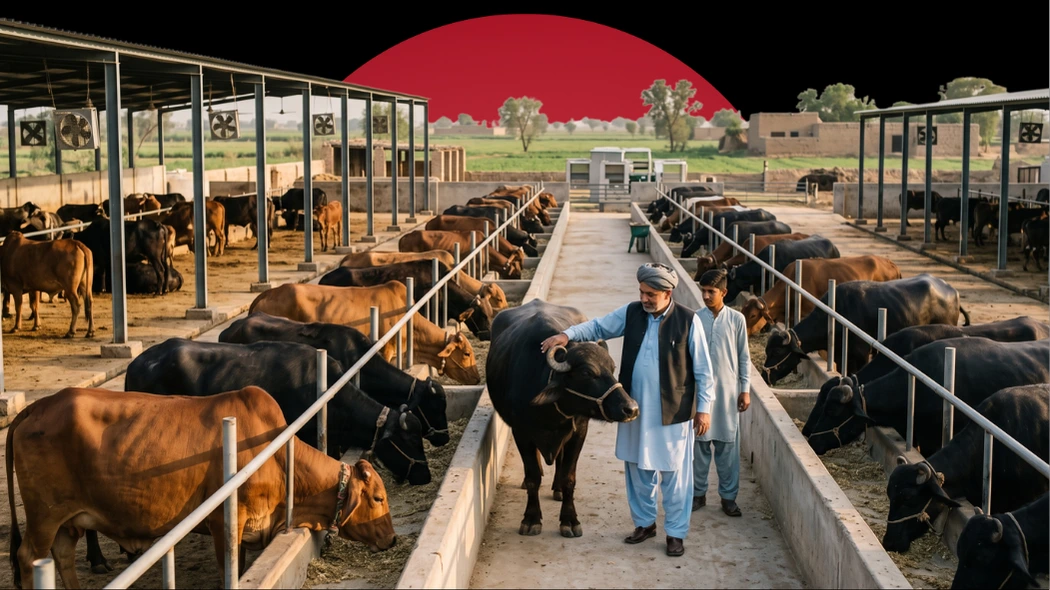
Livestock emerged as the strongest component of the agriculture sector, recording growth of 6.29% in Q1 FY2026, compared with 1.97% a year earlier.
The report attributes the strong livestock performance partly to a decline in the value of inputs. Forestry and fishing also remained in positive territory, growing 2.13% and 0.91%, respectively.
The strong livestock performance helped cushion the impact of weaker crop production and became a key factor behind the overall improvement in agriculture.
Major crops show mixed performance
The performance of major Kharif crops was mixed during the period.
According to the report, sugarcane production increased 1.0%, while rice output rose 2.5% and maize production increased 2.3%. Cotton, however, remained a weak spot, with production declining 1.2% compared with the previous year.
The improvement in important crops represents a significant shift from the severe contraction recorded a year earlier. Nevertheless, the continued decline in the broader crops segment indicates that the recovery remains uneven across agricultural activities.
Agricultural financing and mechanisation gain momentum
The improvement in agriculture was accompanied by stronger financing and investment in farm inputs.
Agricultural credit disbursement increased 11.4% to Rs1.41 trillion during H1 FY2026, compared with Rs1.27 trillion in the same period last year. Meanwhile, imports of agricultural machinery and implements rose 21.6% to $65.8 million, from $54.1 million.
Fertilizer use also increased during the Kharif season. Urea offtake reached around 3.17 million tonnes, up 15.4% from Kharif 2024, while DAP offtake increased 9.5% to 703,000 tonnes. The report links the improvement in fertilizer offtake partly to incentives provided by the Punjab government, including interest-free loans and cash assistance.
For the Rabi season from October to December, urea offtake rose another 26.1% to 2.526 million tonnes, although DAP offtake declined 22% to 543,000 tonnes.
Floods remain a challenge, but wheat outlook improves
Agriculture’s recovery came despite difficult climatic conditions, including floods.
The irrigation system played an important role in supporting Kharif crops. Water availability reported by the Indus River System Authority stood at 60.56 million acre-feet (MAF) during Kharif 2025, marginally higher than 60.48 MAF in Kharif 2024.
The outlook for wheat has also improved. Recent sowing data and satellite imagery, combined with cultivated-area figures, input availability and government-supported incentive programmes, suggest that wheat production could surpass the 29.7 million-tonne target. The report also sees improved prospects for other Rabi crops due to anticipated post-flood yield gains.
Recovery remains incomplete
The first-half report therefore presents a mixed picture of Pakistan’s agriculture sector. Overall growth has accelerated, livestock is expanding strongly and several major Kharif crops have recovered. At the same time, the broader crops segment remains in contraction and cotton continues to face difficulties.
The data also point to stronger agricultural financing, fertilizer use and mechanisation, suggesting increased support for farm activity. The government allocated Rs3.15 billion under the FY2026 PSDP to support agricultural productivity and modernization, including farm inputs, mechanisation and credit facilities.
For Pakistan’s agricultural economy, the key takeaway from the first half of FY2026 is therefore not simply that the sector has returned to growth. Rather, the recovery is being driven disproportionately by livestock, while the crop sector continues to require stronger and more consistent performance.
Source
State of Pakistan — State of Pakistan’s Economy: Half Yearly Report, July–December FY2026. The article above is based on the agriculture-related material contained in the uploaded report.