Media Economics: Dawn Stands Alone as National Dailies Wrap Front Pages in Government PR Jacket.
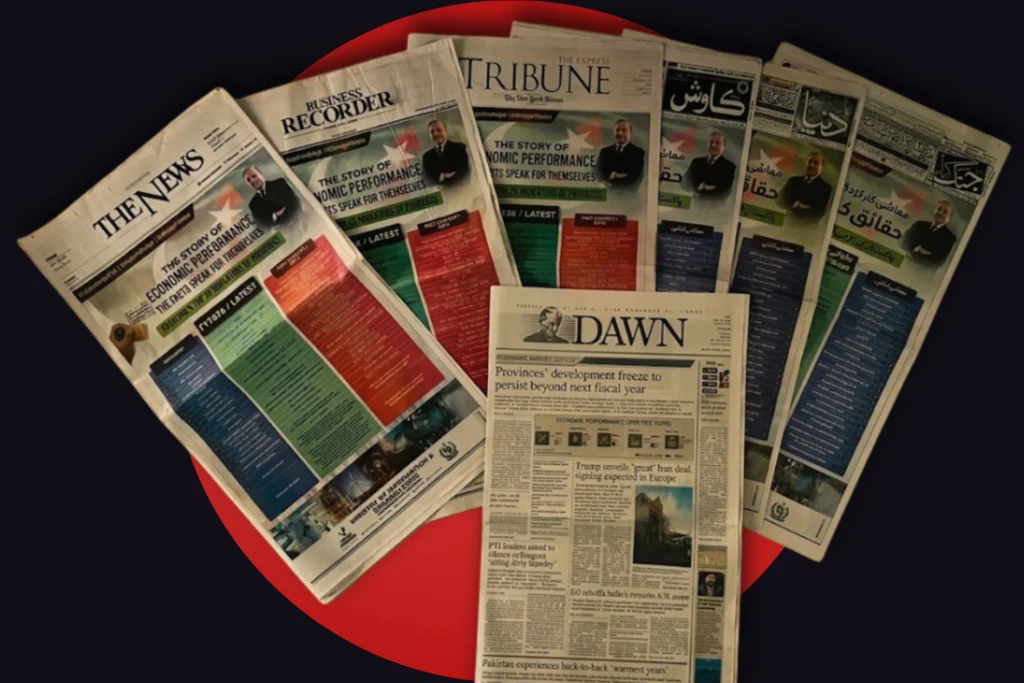
Pakistan Economic Survey media front page jacket advertisement
The release of the Pakistan Economic Survey 2025-26 has highlighted a distinct variance in how major national print media outlets present the country’s fiscal performance. Prominent daily newspapers including The News, Business Recorder, The Express Tribune, Daily Kawish, Daily Dunya, and Jang published their editions wrapped in an identical front-page jacket advertisement sponsored by the Ministry of Information & Broadcasting. Titled “The Story of Economic Performance: The Facts Speak for Themselves,” this coordinated publication layout focuses exclusively on positive macroeconomic highlights, serving as a primary state-level public relations mechanism to broadcast targeted economic milestones across the country.
In sharp contrast, Dawn chose to omit the government-sponsored front-page wrap, opting instead to lead its print layout with regular independent editorial reporting. The newspaper’s main headline, reported by veteran journalist Khaleeq Kiani, focuses on a critical domestic policy update: “Provinces’ development freeze to persist beyond next fiscal year.” Rather than echoing the generalized macroeconomic numbers featured in the surrounding advertising wraps, this reporting details the federal government’s decision to shift over Rs 900 billion away from provincial developmental allocations to address immediate central administrative needs, providing readers with an alternate analytical perspective on the national budget dynamics.
Singing the Same Song: Coordinated Advertising vs. Editorial Independence
As noted by prominent journalist Khurram Husain and highlighted in the print media layout of “Every Front Page In The Country Singing The Same Song …. Except Dawn,” the visual contrast across the country’s newsstands speaks volumes about the economic pressures and choices facing modern journalism. While advertising revenue from the state remains a major financial lifeline for the print industry, the synchronization of front pages effectively unified the mainstream press narrative for a single day.
The key points of divergence in today’s national print layouts include:
- The Coordinated PR Jacket: Six major English and Urdu publications distributed identical full-page wraps emphasizing handpicked macroeconomic indicators under state sponsorship.
- Dawn’s Lonely Stance: By declining the front-page wrap, Dawn preserved its standard editorial layout, putting critical policy journalism ahead of institutional ad space.
- The Rs 900 Billion Structural Shift: Journalist Khaleeq Kiani’s lead report unveiled the central government’s plan to freeze provincial development funds to cover federal operational deficits.
- The Analytical Divide: The split approach leaves citizens navigating two entirely different economic stories one highlighting macroeconomic stability milestones, the other exposing structural strains within provincial fiscal relationships.
The Reality Behind the Provincial Development Freeze
“Every front page in the country singing the same song… except Dawn. When state-sponsored advertising wraps define the visual landscape of newsstands, a newspaper’s decision to stick to traditional editorial headlines serves as a critical reminder of the media’s duty to provide balanced public interest reporting.” — Journalist Khurram Husain
Media analysts and economic commentators suggest that the structural freeze on provincial allocations could complicate upcoming inter-provincial fiscal adjustments. While the coordinated government graphics point to stabilizing reserves and a 3.7% GDP growth framework, the reality on the ground indicates that managing the federal balance sheet is requiring heavy fiscal trade-offs. For business leaders trying to anticipate regional infrastructure growth, independent investigative deep-dives will remain essential for charting the true direction of the economy.
About The Author