Pakistan Pushes 50% Cheaper Iranian Gas, Lower Volumes Amid Weak Demand.
Listen3 min
Read aloud by your device’s built-in synthetic voice, not a recording. Needs a browser that can read aloud.
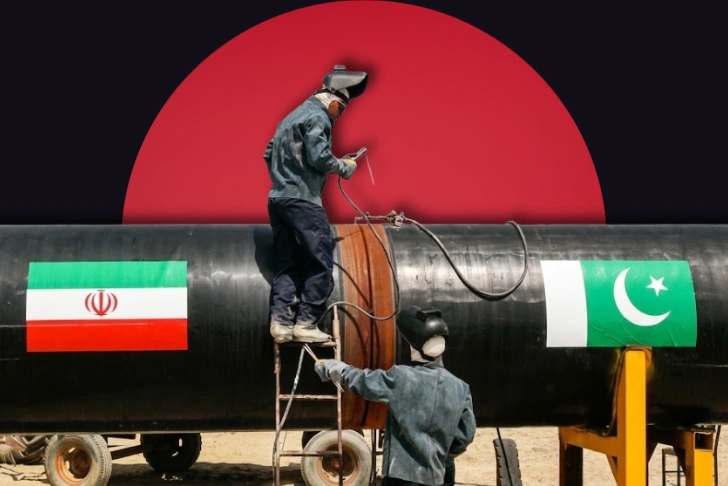
Pakistan is renegotiating the long-delayed Iran-Pakistan (IP) gas pipeline deal, formally seeking a price reduction of up to 50 percent alongside lower contracted volumes from Tehran.
Officials in Islamabad are pressing for the structural changes, arguing that current high prices have left power producers, fertilizer plants, and industrial users unwilling to off-take the imported gas.
Price Benchmark Set at Rs2,000 per mmBtu
Local natural gas is currently supplied at Rs1,500 per mmBtu to fertilizer units and Rs1,000 to domestic consumers. Domestic power plants have drawn a strict threshold at anything above Rs2,000 ($7.14) per mmBtu, which the federal government has now adopted as the sustainable market rate for imported pipeline gas.
The current IP pricing formula puts the rate at $10.60 per mmBtu—translating into nearly Rs2,970—with an additional transportation cost of $1.25 per mmBtu required to move gas from Hub to Nawabshah.
- Comparison with LNG: At global Brent crude levels of $60, $70, and $80 per barrel, the existing IP formula yields $8.20, $9.40, and $10.60 per mmBtu respectively. These rates remain significantly higher than corresponding Liquefied Natural Gas (LNG) rates of $7.14, $8.16, and $9.18 under PSO’s long-term Qatar contract.
- Pakistan’s Counter-Proposal: Islamabad’s new proposal links the gas price to Rs2,000 per mmBtu through a formula set at 6.11 percent of Brent plus a $1 fixed element. This structure produces revised prices of $4.67, $5.28, and $5.89 per mmBtu, undercutting both the original IP contract and current LNG import costs across all crude price scenarios.
Volume Scaling & Contractual Constraints
The IP project carries an estimated capital cost of $2.5 billion for a design capacity of 750 million cubic feet per day (mmcfd).
However, Pakistani officials are pushing to scale back contracted import volumes. The country must first absorb its existing long-term Qatar LNG cargoes to avoid take-or-pay contractual penalties, leaving narrow absorption capacity for additional high-volume Iranian supplies.
Policy decisions are heavily influenced by earlier experiences with expensive imported LNG, which previously forced the diversion of 24 cargoes and resulted in substantial financial losses for domestic exploration and production (E&P) companies due to forced field curtailments.
Arbitration History and Sanctions Relief
Project progress remains fundamentally tied to US sanctions waivers. Pakistan has informed Tehran that construction on its side of the border can only proceed if the US administration grants explicit regulatory relief, hoping that broader diplomatic engagements will open a path forward.
The original 2009 inter-governmental declaration and subsequent Gas Sale and Purchase Agreement (GSPA) signed between Inter State Gas Systems (ISGS) and the National Iranian Oil Company (NIOC) have seen repeated deadline extensions. Because construction on the Pakistani segment never commenced due to international sanction threats, Iran previously initiated international arbitration proceedings.
Both governments are now attempting to find a mutually acceptable, out-of-court commercial solution that addresses import prices, contracted volumes, and legal exposure. A substantially cheaper and smaller IP supply package is viewed by policymakers as the only commercially viable path to revive the project.