Livestock emerges as Pakistan’s key agricultural growth engine in FY2026
Listen4 min
Read aloud by your device’s built-in synthetic voice, not a recording. Needs a browser that can read aloud.
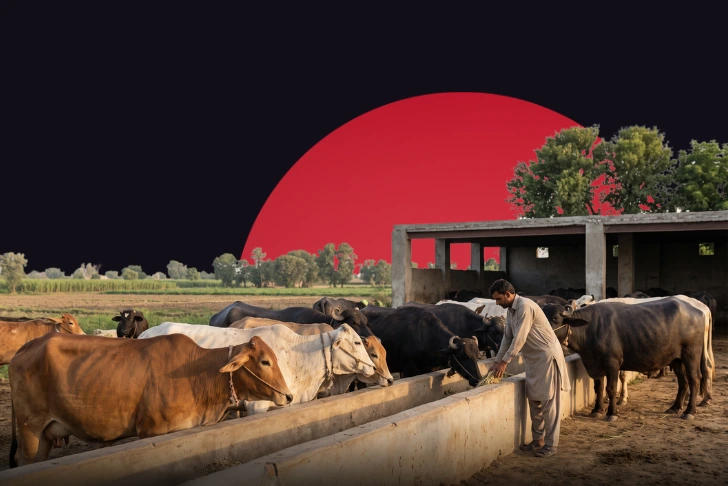
Pakistan’s livestock sector has emerged as the strongest driver of agricultural growth in the first quarter of fiscal year 2026, highlighting the increasing importance of livestock in the country’s rural economy as crop performance remains mixed.
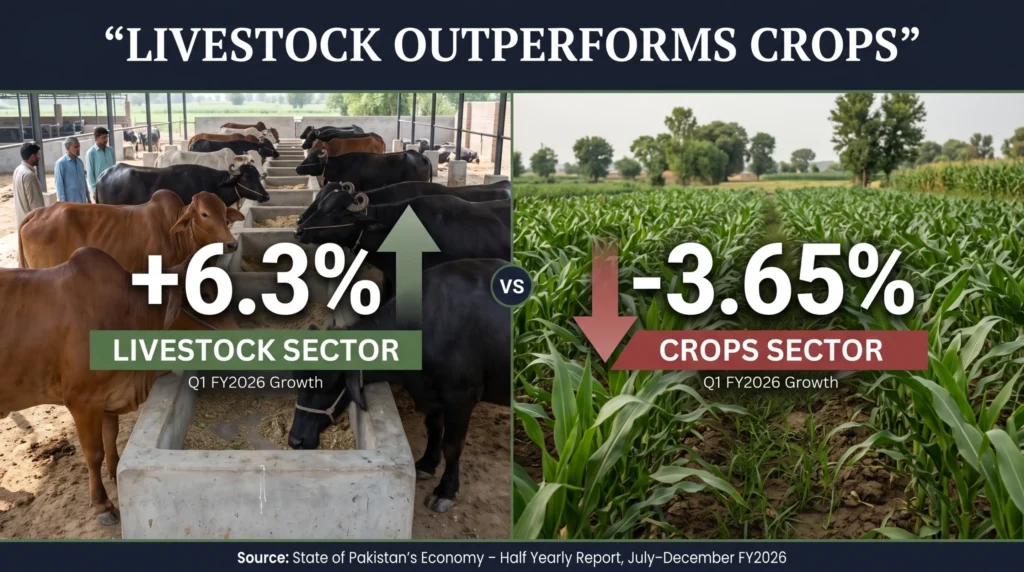
According to the State Bank of Pakistan’s “State of Pakistan’s Economy, Half Yearly Report, July–December FY2026,” Pakistan’s agriculture sector grew by 2.9 percent in Q1 FY2026, compared with 1.0 percent in the same period last year. Livestock recorded the strongest performance within the sector, expanding by 6.3 percent, sharply up from 2.0 percent in Q1 FY2025.
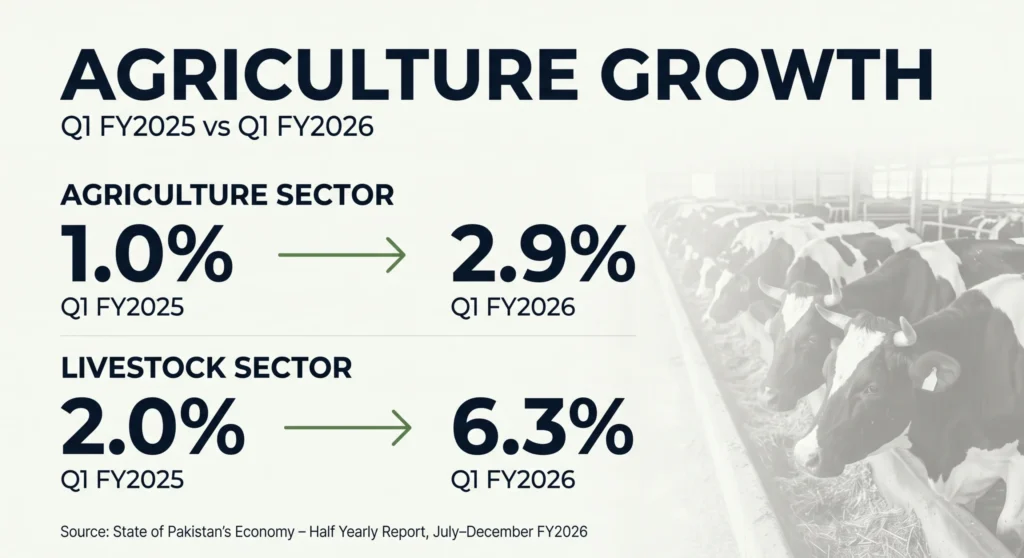
The report attributes the strong livestock performance partly to a decrease in the value of inputs, while livestock continued to provide resilience to the agriculture sector following the challenges faced by crops. (Finance Division)
The contrast with crops is significant. The overall crops segment contracted by 3.65 percent in Q1 FY2026. However, important crops showed considerable improvement, with their contraction narrowing to 0.75 percent, compared with a 13.07 percent decline in the same quarter last year.
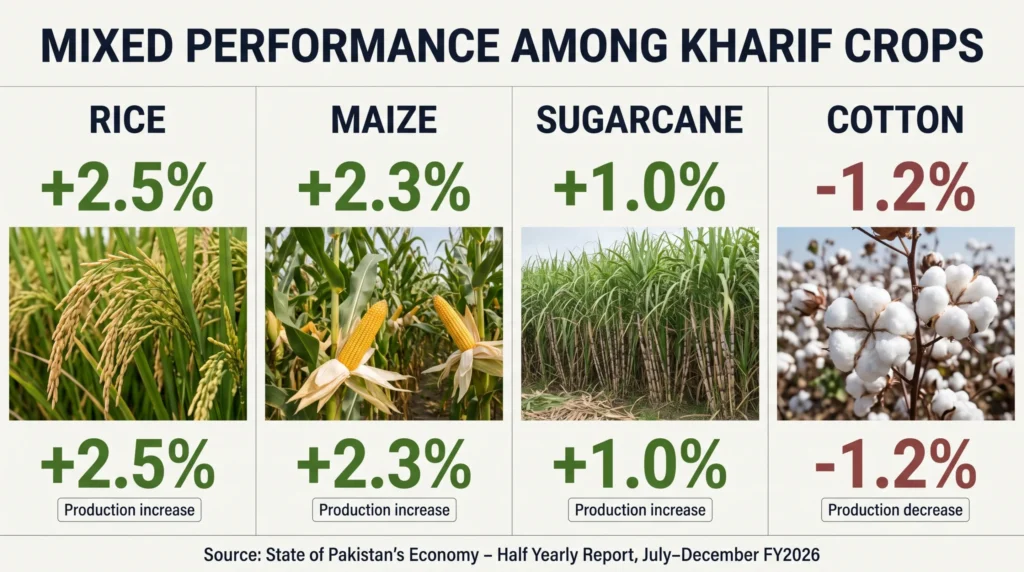
The performance of major Kharif crops was also mixed. Sugarcane production increased 1.0 percent, rice 2.5 percent and maize 2.3 percent, while cotton production declined by 1.2 percent.
Against this backdrop, the livestock sector’s 6.3 percent expansion stands out as the major positive development within agriculture. Forestry and fishing also maintained positive growth, at 2.1 percent and 0.9 percent, respectively.
Financing and farm investment also strengthen
The livestock-led agricultural recovery has coincided with stronger financing and investment across the wider farm economy.
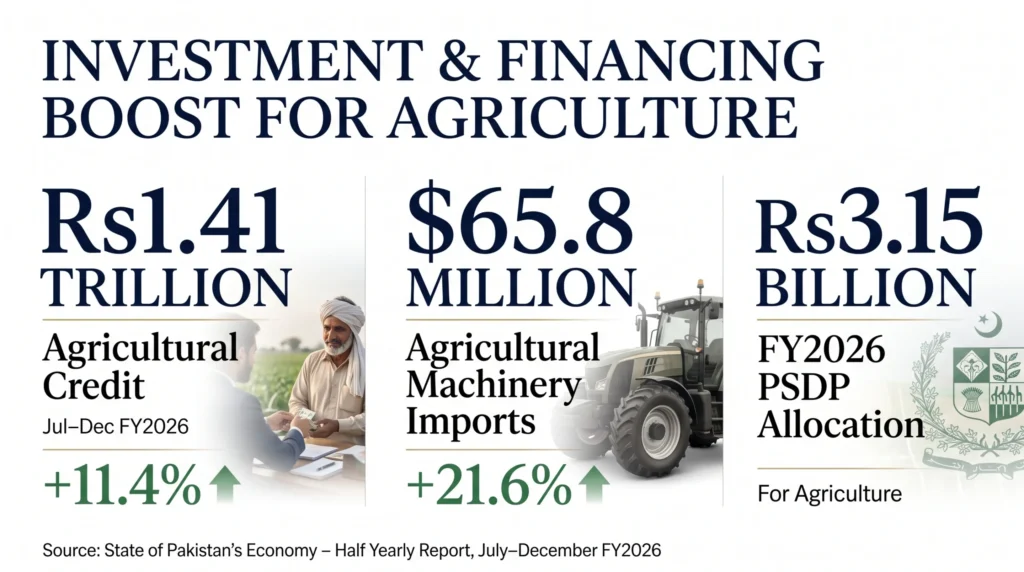
Agricultural credit disbursement during the first half of FY2026 increased 11.4 percent to Rs1.41 trillion, compared with Rs1.27 trillion during the corresponding period last year. Imports of agricultural machinery and implements also rose 21.6 percent to $65.8 million, from $54.1 million.
Input use also strengthened. Urea offtake during the Kharif 2025 sowing season reached approximately 3.17 million tonnes, up 15.4 percent from the previous year, while DAP offtake increased 9.5 percent to 703,000 tonnes.
The report also notes that the government allocated Rs3.15 billion under the FY2026 PSDP for agriculture, with emphasis on productivity and modernization through farm inputs, mechanization and credit facilities.
For livestock, the strong growth is particularly important because it demonstrates that Pakistan’s agricultural performance is not solely dependent on crop production. The sector’s expansion provides an additional source of rural economic activity and reinforces the role of livestock in Pakistan’s broader agricultural economy.
However, the report also points to a major challenge: stronger domestic agricultural activity has not translated into stronger food export earnings. Pakistan’s food exports fell 35.5 percent to $2.31 billion during July–December FY2026, compared with $3.58 billion in the same period last year.
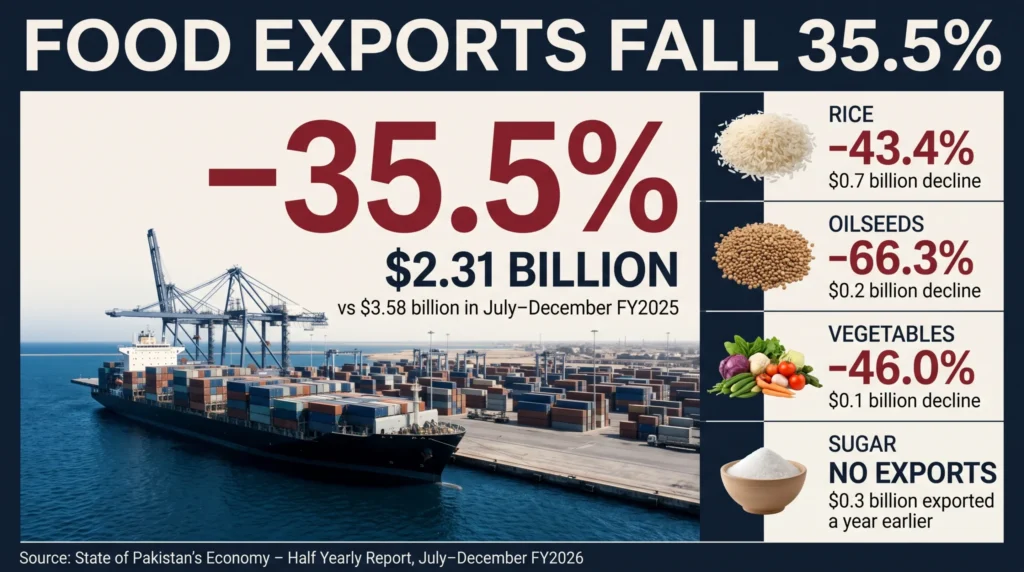
The decline was driven mainly by lower rice, oilseed and vegetable exports, while Pakistan recorded no sugar exports during the period compared with $0.3 billion a year earlier.
This creates a mixed picture for Pakistan’s agriculture sector: livestock is providing a powerful source of growth, agricultural financing and mechanization are increasing, and major crops are recovering from last year’s contraction — but the sector still faces challenges in converting agricultural activity into stronger export earnings.
Sources