
The Great AI Reversal
Listen8 min
Read aloud by your device’s built-in synthetic voice, not a recording. Needs a browser that can read aloud.

Why Developed Economies Face the Brunt of AI Disruption First
There is widespread anxiety that artificial intelligence will hit developing nations first by wiping out low-cost outsourcing and blue-collar jobs. But, as history has shown, things do not always turn out as expected. In this case, the data tells a surprisingly different story.
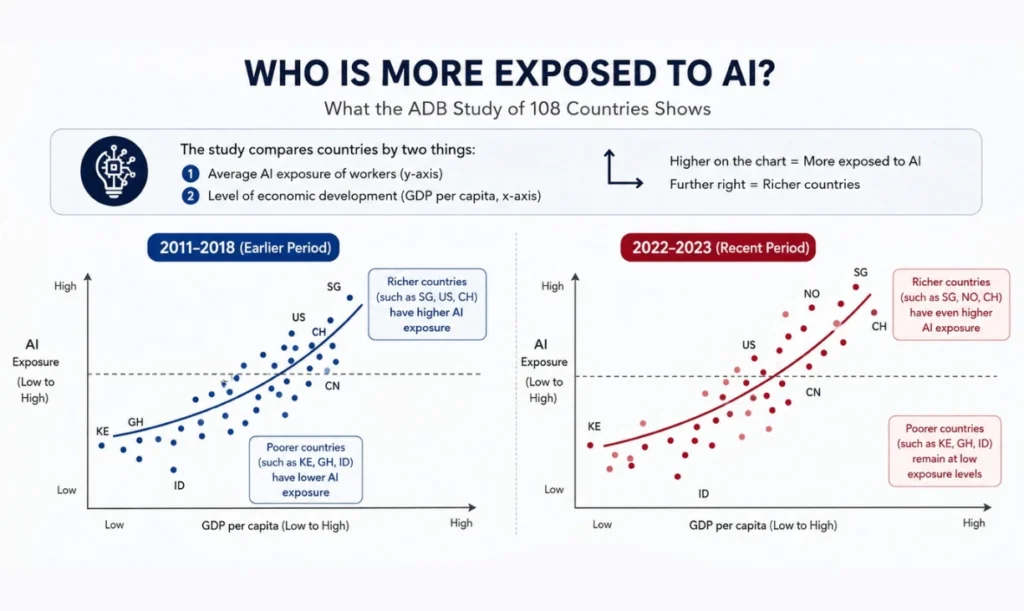
A recent study by Piotr Lewandowski, Karol Madoń, and Albert F. Park, Chief Economist of the Asian Development Bank, examines workers’ exposure to artificial intelligence across 108 countries, covering approximately 89% of global employment. Its findings challenge some common assumptions about where AI disruption will be felt most strongly.
The study finds that workers in low-income countries are, on average, less exposed to AI than workers in high-income countries. At the global level, high-income countries account for 59.1% of the world’s most AI-exposed workers. In stark contrast, low- and lower-middle-income economies account for 61.8% of the least exposed workers.
The same job title does not mean the same AI exposure
One of the important problems with measuring AI’s potential impact is assuming that the same job title represents the same work everywhere.
Consider a manager in a highly developed economy. Much of their work might involve analysing data, preparing reports, using sophisticated software, communicating digitally, and managing information. Many of these tasks are increasingly capable of being assisted or automated by AI.
Now consider a manager in a developing economy with the same job title. Their work might involve supervising employees in person, visiting worksites, dealing directly with suppliers, and handling practical problems on the ground. The job title is the same, but the tasks are fundamentally different.
Therefore, applying the AI exposure level of a manager in the United States to managers in developing countries could overestimate the degree to which AI is likely to affect those workers.
This task-level distinction is central to the ADB study. The researchers find that differences in the tasks performed within occupations account for roughly 78% of the variation in AI exposure, while differences in occupational structure account for about 22%. In other words, what workers actually do may matter more than what their job titles are called.
The developing world may have more time than expected
The findings create an interesting reversal in the conventional AI narrative. High-income countries currently employ the largest share of workers in highly AI-exposed occupations. Meanwhile, low- and lower-middle-income countries have a disproportionately large share of workers in the least exposed occupations.
This suggests that the immediate effects of AI may be felt more strongly in advanced economies, where workers are already performing more digitally intensive and AI-exposed tasks.
But there is an important distinction to make: lower AI exposure does not mean lower AI risk.
The study measures exposure, not actual job displacement. The researchers explicitly note that their analysis cannot determine whether AI will ultimately complement workers or substitute for them. Actual outcomes will depend on how quickly AI is adopted, whether the technology is technically capable of replacing particular tasks, and whether doing so is economically worthwhile. That distinction matters because it changes how developing economies should interpret these findings.
Pakistan should not mistake low exposure for protection
For countries such as Pakistan, the findings raise a more difficult question. Is relatively low AI exposure a sign of resilience, or is it partly a sign that the economy has not yet adopted enough technology for the full effects of AI to emerge?
The answer may be closer to the latter than many would assume.
The study finds that differences in ICT intensity and technological capability explain a large portion of the variation in AI exposure between countries. It also finds a positive relationship between AI exposure, education, and cognitive skills.
This means that a country can have relatively low AI exposure not necessarily because its workers are protected from technological change, but because its workplaces have lower levels of digital adoption and technological intensity.
That creates a very different policy challenge for Pakistan. The immediate question may not simply be how to protect Pakistani workers from AI replacing their jobs. It may be how to prepare Pakistani workers, businesses, and institutions for a future in which AI adoption becomes much more widespread.
The AI gap could become an economic gap
This is where the issue becomes larger than employment. The ADB study warns that differences in ICT infrastructure and digital readiness could widen the technological and economic divide between advanced and emerging economies.
If advanced economies adopt AI more quickly, they may begin using it to increase productivity, improve services, and transform the way businesses operate, while developing economies remain concentrated in less technology-intensive activities. The result could be a new form of economic divergence.
The countries that are currently most exposed to AI may face greater disruption, but they are also the countries that are already building the infrastructure, skills, and institutions required to capture its benefits. Developing economies could therefore face a different risk: not being disrupted by AI quickly enough to benefit from it.
Pakistan’s window to prepare
Lower AI exposure could give developing countries valuable time. But that time is only useful if it is used to prepare.
Pakistan’s policy response should therefore extend beyond simply discussing which jobs AI might replace. The country needs to consider the foundations that determine whether workers and businesses can actually benefit from AI. That includes strengthening digital infrastructure, improving the quality of education, developing AI and digital skills, encouraging technology adoption among businesses, and preparing workers for changing task requirements.
The ADB study itself finds that ICT intensity and human capital are important factors associated with differences in AI exposure across countries. This suggests that Pakistan’s AI strategy cannot simply be about producing AI models or announcing ambitious technology initiatives. It must also be about building the workforce and digital economy capable of using those technologies.
The real question is not whether AI will reach Pakistan
The debate around AI often asks whether the technology will eventually take our jobs. For developing economies, that may not be the most useful question yet. A more important question is whether we will be prepared when AI becomes deeply integrated into our economy.
The current lower level of AI exposure in developing economies should not create complacency. It may instead represent a window in which governments can invest in infrastructure, human capital, and digital readiness before AI adoption accelerates.
The AI disruption may arrive in developing economies later, but arriving later does not necessarily mean arriving less forcefully. For Pakistan, the real danger may not be that AI reaches the country too early. It may be that AI reaches Pakistan after the rest of the world has already built the skills, infrastructure, and institutions needed to benefit from it. That is the gap Pakistan needs to close before the next phase of the AI economy arrives.
Source: WORKERS’ EXPOSURE TO ARTIFICIAL INTELLIGENCE ACROSS DEVELOPMENT STAGES