THE HORMUZ MYTH: Why Pakistan Alone Bears the Brunt of Daily Fuel Shocks
A Macroeconomic Assessment of Pass-Through Mechanics, Regional Policy, and Household Welfare
If the closure of the Strait of Hormuz is truly starving South Asia of affordable fuel, why did petrol prices in Mumbai barely move, while pumps in Sri Lanka became cheaper? Whenever fuel prices jump in Pakistan, official explanations point quickly to global waters.
Over the past ten weeks, policymakers and government representatives have accused maritime unrest and increased premiums on shipping risk in the Persian Gulf of the cause of the persistent increase in domestic pump tariffs. The story is believable at first sight. Gulf ports export crude oil and refined distillates to Pakistan, which constitute by far the largest part of its imports, and any danger to strategic sea routes will inevitably increase benchmarks on land.
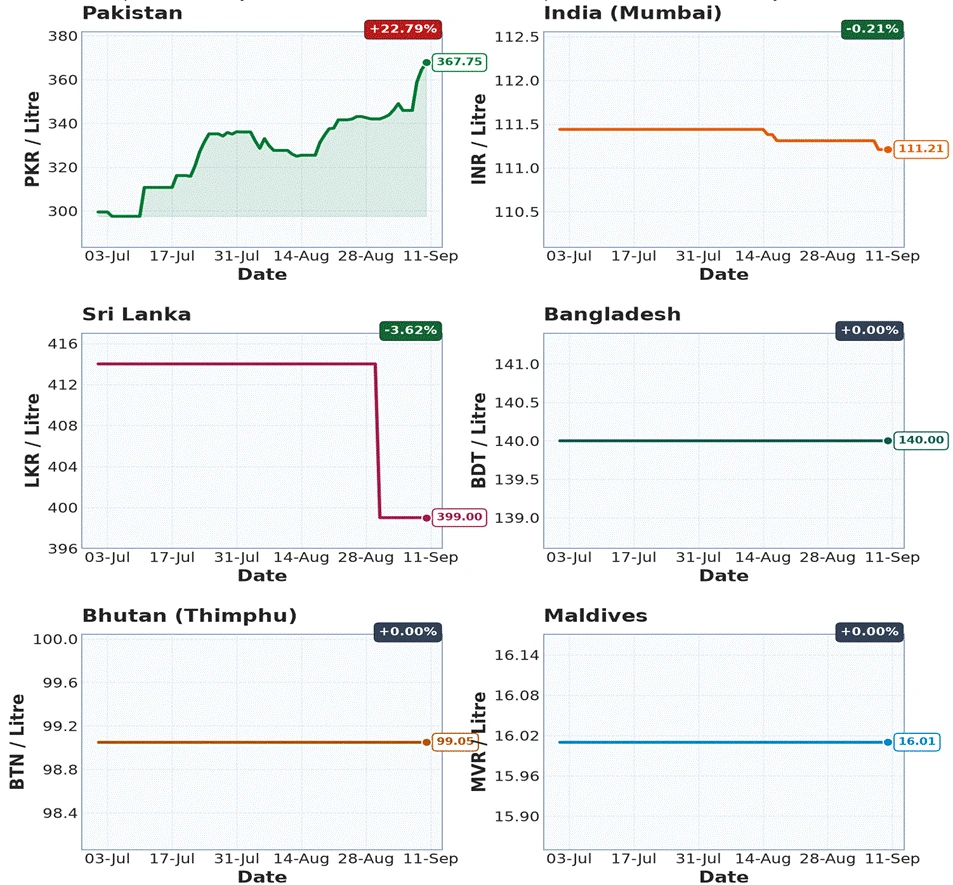
Yet economic arguments must withstand comparative empirical criticism. The South Asian economies have the same geography and reliance on the same shipping lanes. Had it been physical bottlenecks in Hormuz or tanker insurance surcharges that were the real engine behind the current surge in retail fuel prices, pump prices in New Delhi, Colombo, and Dhaka would have risen in unison. On the contrary, day-by-day reports between July 1 and September 10, 2026, indicate that Pakistan is all alone. As regional neighbors cushioned their people or transmitted price cuts, Pakistan absorbed all the risk of spot volatility onto households and companies, using a vigorous daily price formula. Across seventy-two consecutive days, Pakistan was the sole economy in the subcontinent to experience relentless upward retail volatility.
Normalization of retail fuel prices throughout South Asia removes currency noise and shows a sharp policy divergence. As global crude markets were fluctuating, local neighbours ensured a slow domestic stability of prices. Throughout this seventy-two-day period, Pakistan experienced thirty-eight different price changes, while peer countries changed tariffs once or maintained them at zero.
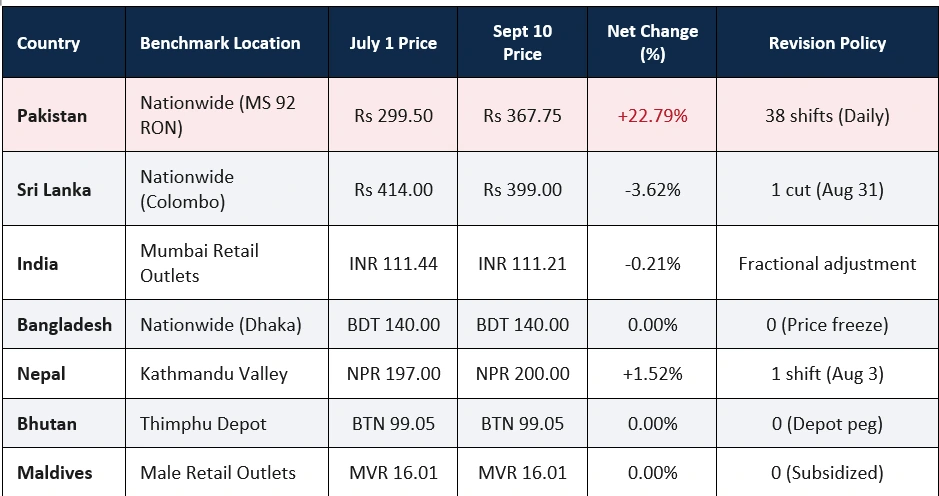
If global shipping hazards were real, how did other regional economies prevent pump prices from exploding? They did not rely on economic miracles. They relied on deliberate institutional buffers and counter-cyclical smoothing. On paper, India maintains daily dynamic pricing. In practice, public oil marketing companies function as shock absorbers. When international crude prices ease, refiners build fiscal cushions by expanding retained margins. When shipping or crude prices spike, refiners compress those margins rather than passing instant price spikes to consumers. During the height of recent shipping tensions, Indian refiners absorbed losses of approximately five rupees per litre on petrol and twenty-three rupees on diesel, keeping Mumbai pump prices stable within a narrow paise band.
Following its recent financial crisis, Sri Lanka adopted a cost-reflective monthly pricing formula administered by CEYPETCO. Far from suffering Hormuz-driven price hikes, authorities held petrol steady at 414 rupees per litre through July and August. On August 31, they enacted a fifteen-rupee price cut down to 399 rupees per litre, directly passing lower landed product costs to citizens. Bangladesh froze petrol rates at 140 taka per litre throughout the quarter. Recognizing that unpredictable fuel tariffs cripple export manufacturing, freight transport, and agricultural tubewells, the government chose price certainty over daily pass-through. Bhutan similarly deployed its fuel price smoothing framework, ensuring that landlocked freight corridors remained protected from spot market shocks.
If the Strait of Hormuz does not explain why Pakistan surged by 22.79 per cent while neighbors stayed flat, what does? The answer lies in two domestic policy decisions: the transition to daily pass-through pricing and aggressive fiscal extraction.
On July 17, 2026, the Petroleum Division officially discontinued its weekly review of prices in favor of daily revaluations, using rolling Platts Arab Gulf product benchmarks. Though daily pricing is in line with orthodox market theory, its application in an economy with weak foreign exchange reserves and expensive transportation led to widespread disruption. Instead of filtering out short-term paper trading spikes in international oil hubs, the daily formula transmitted speculative spot noise directly to retail pumps. Across seventy-two days, petrol prices adjusted thirty-eight times, making forward freight and production planning nearly impossible for Pakistani enterprises.
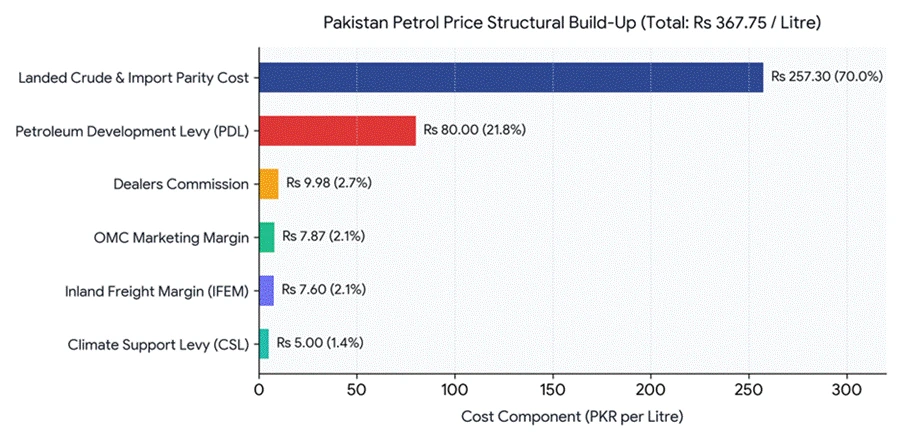
More importantly, nearly one-third of what Pakistani motorists pay at the pump consists of government levies and fixed margins. When retail prices jump, the state is often satisfying revenue collection benchmarks rather than paying for landed crude oil. Of the Rs367.75 retail petrol price, landed crude and refining parity account for Rs257.30 (70.0pc). The remaining Rs110.45 (30.0pc) is made up of statutory charges: Petroleum Development Levy at Rs80.00, Climate Support Levy at Rs5.00, distribution and dealer margins at Rs17.85, and inland freight equalization at Rs7.60. Because broad-based direct income tax collection remains weak, the state uses fuel consumption as a surrogate tax collector.
Motor fuel carries a direct weight of roughly 3.05pc in Pakistan’s Consumer Price Index basket. The 22.79pc increase generates an immediate direct contribution of 0.70 percentage points to headline inflation. However, the second-round effects are far larger. Commercial road transport handles over 90pc of domestic freight in Pakistan. Higher pump prices instantly inflate inter-city trucking rates, urban delivery fees, agricultural tractor costs, and wholesale mandi transport. Factoring in these compounding second-round pressures across food and manufactured distribution, the total addition to headline CPI inflation reaches between 1.45 and 1.60 percentage points.
A rigorous, definitive estimate of poverty headcount requires the Household Integrated Economic Survey examining micro-level expenditure baskets. Nonetheless, typical empirical elasticities recorded by the Pakistan Institute of Development Economics and the World Bank indicate that every one percentage point rise in non-food inflation displaces about 250,000 vulnerable people below the poverty line. Under these empirical parameters, this fuel price spike endangers 340,000 to 400,000 individuals with the imminent threat of dropping below the lower-middle-income poverty threshold ($3.65 per day) and results in low-income households being forced to make harsh trade-offs between food, education, and health care.
The empirical data makes one reality inescapable: blaming the Strait of Hormuz for Pakistan’s domestic fuel inflation does not survive comparative scrutiny. India, Sri Lanka, and Bangladesh navigated the same geopolitical quarter with steady or falling pump prices. They achieved this through deliberate policy choices, including corporate shock absorption, monthly formula smoothing, and tariff freezes.
No economist disputes that Pakistan must avoid reckless, open-ended fuel subsidies that widen the fiscal deficit. However, fiscal discipline does not require maximum speed of pass-through. By operating an unbuffered daily pricing mechanism alongside heavy statutory levies, Pakistan has transferred all market risk directly onto households and productive enterprises. Restoring economic competitiveness requires establishing counter-cyclical smoothing mechanisms and transparent fiscal buffers that protect businesses from destructive short-term volatility.
DISCLAIMER
The views expressed in this article are the author's own and do not represent the position of any institution or organization the author is affiliated with. This piece is for general informational and educational purposes only and should not be relied upon as investment, policy, or financial advice. No responsibility is accepted for actions taken based on this content.