StarCharge, McDonald’s Pakistan Explore EV Charging Partnership
Listen2 min
Read aloud by your device’s built-in synthetic voice, not a recording. Needs a browser that can read aloud.
✧ GENERATE BRIEFING
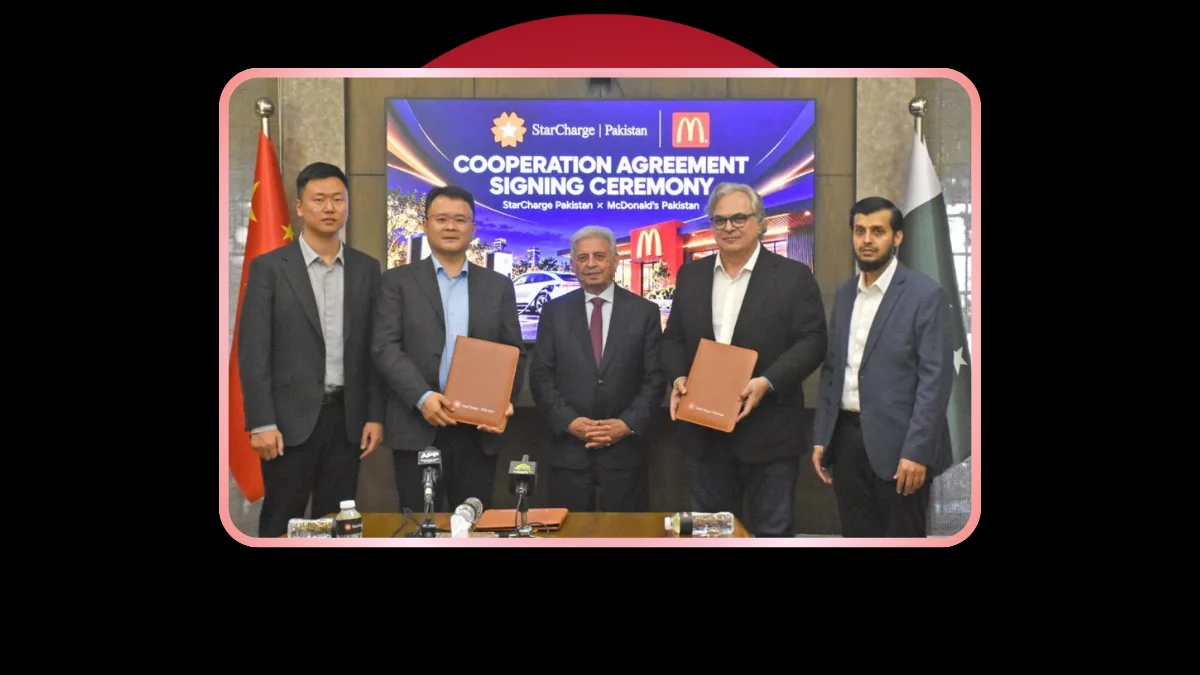
Global EV charging hardware and smart microgrid provider StarCharge has entered into a strategic cooperation agreement with McDonald’s Pakistan to explore deploying electric vehicle (EV) charging stations across select quick-service restaurant (QSR) locations nationwide. Federal Minister for National Food Security and Research Rana Tanveer Hussain formally endorsed the public-private initiative, framing it as a catalyst for sustainable mobility and commercial transport decarbonization. Key operational, feasibility, and policy dynamics of the initiative include: Destination Charging Model: The proposed collaboration integrates high-speed DC chargers at high-footfall drive-thru and QSR sites, allowing electric vehicle owners to top up battery capacity during meal times. Site Feasibility & Evaluation: Deployment timelines, site selection, and capital expenditure remain subject to ongoing technical feasibility assessments, focusing on transformer grid connections, load availability with local Distribution Companies (DISCOs), and commercial footfall metrics.
StarCharge and McDonald’s Pakistan have signed a cooperation agreement to explore the installation of electric vehicle (EV) charging facilities at selected McDonald’s locations across Pakistan, as the country seeks to expand its green transport infrastructure.
The agreement brings together StarCharge’s expertise in EV charging technology and smart energy solutions with McDonald’s extensive network of restaurants, potentially allowing customers to charge their electric vehicles while dining.
Federal Endorsement and Sustainable Mobility
Federal Minister for National Food Security and Research Rana Tanveer Hussain welcomed the partnership, describing it as a positive step towards cleaner transportation, technological innovation and sustainable infrastructure development.
Under the agreement, both companies will assess potential locations before proceeding with installations. The evaluation will consider technical feasibility, infrastructure requirements and commercial viability, according to the government’s press release.
Commercial Framework and Deployment Feasibility
The proposed collaboration could improve convenience for EV owners by integrating charging facilities into locations that customers already visit. However, the agreement currently focuses on exploring opportunities; the government announcement did not specify the number of charging stations, investment amount or installation schedule.
The minister said greater availability of charging infrastructure could help reduce dependence on conventional fuels, lower transport-related emissions and encourage wider adoption of electric vehicles.
Public-Private Partnerships and Green Transition
He also highlighted the importance of public-private partnerships in attracting investment into emerging sectors and translating technological advances into practical benefits for consumers.
The initiative reflects growing interest in Pakistan’s electric mobility market, where the expansion of charging facilities will be important for supporting EV adoption and building a more sustainable transport system.