
Foreign Companies spent PKR 15 Billion on Corporate Social Responsibility (CSR)
Listen3 min
Read aloud by your device’s built-in synthetic voice, not a recording. Needs a browser that can read aloud.
KARACHI — Foreign and multinational companies operating in Pakistan have significantly scaled their social development footprint, mobilizing a total of PKR 15.33 billion toward Corporate Social Responsibility (CSR) initiatives over the past year. According to the latest Corporate Social Responsibility Report released by the Overseas Investors Chamber of Commerce and Industry (OICCI), this capital injection represents a steady 10 percent increase over the previous year’s contributions, directly benefiting more than 44 million individuals nationwide.
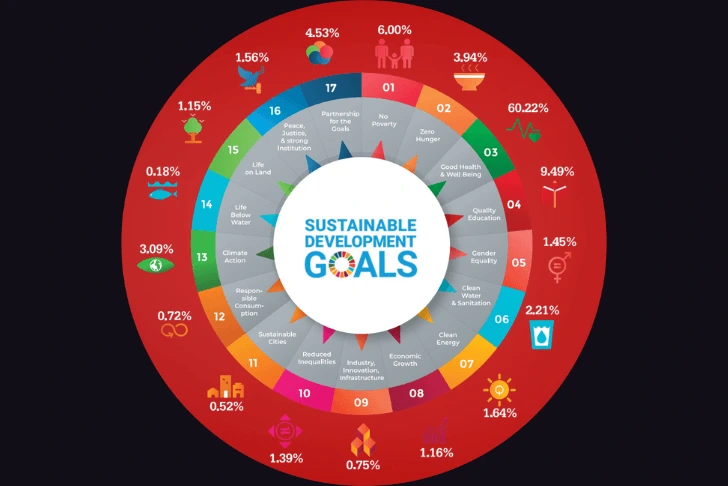
The report highlights a highly structured approach to addressing national challenges, dividing the total contribution into two primary funding streams. A dedicated allocation of PKR 4.5 billion was channeled傲 exclusively toward frontline flood relief, rehabilitation, and emergency aid. The remaining core development fund of PKR 10.83 billion was strategically mapped against the United Nations Sustainable Development Goals (SDGs) to drive systemic change across critical social and economic sectors.
Among the core SDG allocations, SDG 3 (Good Health & Well-being) received the highest priority, absorbing 60.22 percent of the core budget. These funds were utilized for infrastructure upgrades, medical camps, and free or subsidized healthcare services. SDG 4 (Quality Education) followed as the second-largest priority at 9.49 percent, funding scholarships, vocational training, STEM platforms, and digital learning labs. Other significant allocations included 6.00 percent for SDG 1 (No Poverty) through financial inclusion and micro-enterprise development, 4.53 percent for SDG 17 (Partnerships for the Goals), 3.94 percent for SDG 2 (Zero Hunger), and 3.09 percent for SDG 13 (Climate Action).
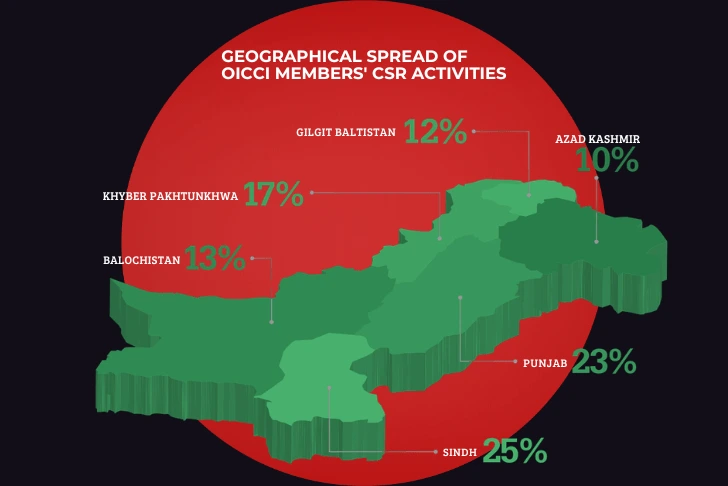
Geographically, the interventions maintained a balanced national outreach. Sindh received the largest share at 25 percent, followed closely by Punjab at 23 percent. Khyber Pakhtunkhwa accounted for 17 percent, Balochistan for 13 percent, Gilgit-Baltistan for 12 percent, and Azad Jammu & Kashmir (AJK) for 10 percent. This vast operational network was made possible by mobilizing over 13 million volunteer work-hours and establishing partnerships with more than 270 social sector organizations.
The report also detailed individual corporate profiles contributing to these benchmarks. Meezan Bank advanced renewable energy initiatives through solar power installations at hospices and launched Pakistan’s first Sovereign Green Sukuk. Faysal Bank focused on national school solarization with TCF and women’s professional development through its Khud Mukhtar program. Meanwhile, PARCO established girls’ digital computer labs and community water filtration plants, and Jazz deployed an AI-backed early warning system in collaboration with the NDMA and GSMA. Together, these documented corporate efforts demonstrate a concerted, data-driven commitment to shaping a sustainable tomorrow for the country.

 Investments
 Investments
 Investments