
Pakistan, Iran Agree Roadmap to Expand Trade & Investment Cooperation.
Listen3 min
Read aloud by your device’s built-in synthetic voice, not a recording. Needs a browser that can read aloud.
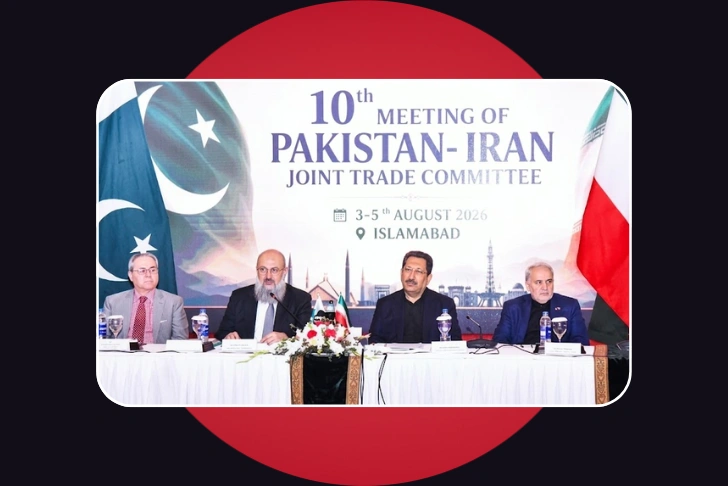
Pakistan and Iran have reaffirmed their commitment to significantly expanding bilateral trade and investment, establishing a joint roadmap to achieve a shared annual trade target of $10 billion through a proposed Free Trade Agreement (FTA), expanded business collaboration, and upgraded border infrastructure.
The agreement was formalized during the 10th Session of the Pakistan-Iran Joint Trade Committee (JTC), co-chaired in Islamabad by Federal Minister for Commerce Jam Kamal Khan and Iran’s Minister of Industry, Mines and Trade Dr. Mohammad Atabak. At the conclusion of the two-day summit, officials signed agreed minutes covering trade facilitation, industrial partnership, investment promotion, and transit connectivity.
Accelerating Free Trade & Barter Mechanisms
Both delegations reviewed progress on the proposed Pakistan-Iran FTA, focusing on tariff reductions, standardized rules of origin, and expanding product coverage.
Key trade expansion priorities agreed upon include:
- Barter Trade Expansion: Enhancing non-banking barter mechanisms to navigate international banking and sanction-related constraints.
- Joint Border Markets: Operationalizing border trade hubs to support local economies along the 900-kilometer shared border.
- Customs & Logistics Streamlining: Extending border crossing operational hours and expediting customs clearances, particularly for perishable agricultural goods.
- Port Utilization: Leveraging Karachi and Gwadar ports as strategic gateways for trade re-exports and supply chain integration.
Regional Transit Corridor & B2B Engagement
Separately, a high-level Iranian delegation met with Federal Minister for the Board of Investment Qaiser Ahmed Sheikh to discuss direct foreign investment opportunities in Pakistan’s 250-million-person consumer market.
Delegates explored the development of a strategic regional trade corridor connecting Karachi, Rimdan, Bam, and potentially Chabahar through joint public and private investments.
The Iranian delegation included representatives from the Kerman and Tehran Chambers of Commerce, showcasing Kerman province’s economic significance as a leading mining hub, home to four economic zones, and a major producer of pistachios and dates. More than 1,000 business-to-business (B2B) meetings have already been conducted between Pakistani entrepreneurs and commercial representatives from Kerman.
Agricultural Trade & Priority Sector Growth
Highlighting agricultural synergy, Iranian representative Shahrooz Shariat noted that Iran imports approximately one million tonnes of rice annually, with Pakistan currently supplying around 40 percent of those imports—offering substantial room for further expansion.
The Board of Investment identified several high-priority sectors for joint ventures:
- Rice Processing & Agriculture
- Petrochemicals & Steel
- Auto Parts & Engineering Services
- Testing, Inspection, and Certification Services
Both nations expressed confidence that deeper private-sector engagement, improved customs logistics, and the eventual implementation of the FTA will systematically scale bilateral commerce from its current levels toward the $10 billion milestone.

 Investments
 Investments
 Investments