
Pakistan Needs New Skills Agenda to Turn Youth Potential Into Decent Work.
Listen3 min
Read aloud by your device’s built-in synthetic voice, not a recording. Needs a browser that can read aloud.
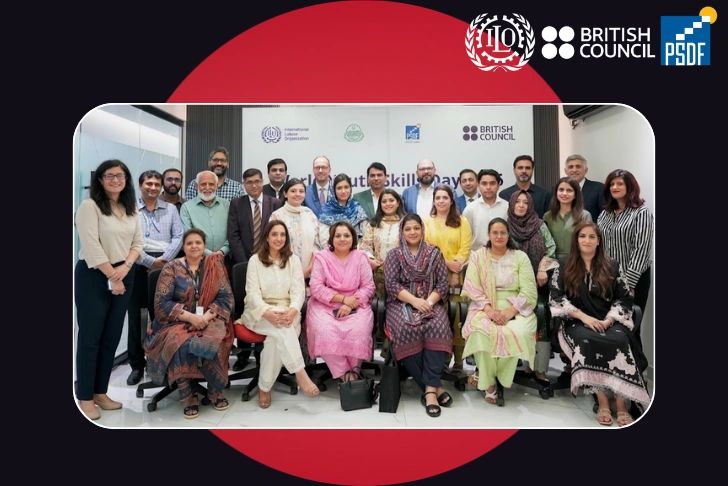
Pakistan must strengthen the connection between skills development and labour market demand if it is to equip its young people for a world of work increasingly shaped by digitalization, artificial intelligence, climate change, and demographic change, participants emphasized at a high-level roundtable marking World Youth Skills Day.
The event, titled “Skills for a Shared Future,” was jointly convened by the International Labour Organization (ILO), the Punjab Skills Development Fund (PSDF), and the British Council.
Scale of the Challenge
The call comes as new data highlights key challenges within the national labor market:
- Youth Population: Pakistan has an estimated 46.3 million young people aged 15–24.
- Labor Force Participation: 20.6 million participate in the labor force, while 2.6 million are unemployed.
- Unemployment Rate: The youth unemployment rate stands at 12.8%—nearly double the overall national rate of 7.1%.
- NEET Rate: 28.4% of young people (more than one in four) remain outside employment, education, or training (NEET).
- Vocational Reach: Around 4.9 million young people (3.0 million men and 1.9 million women) have received technical or vocational training, underscoring the need to expand access—particularly for women.
Industry Leadership and Expert Perspectives
Speaking on the required shift in the technical and vocational education and training (TVET) ecosystem, Geir Tonstol, Director of the ILO Country Office for Pakistan, stated:
“Pakistan needs a training ecosystem that keeps pace with industry, supports innovation and prepares young people for jobs that are emerging today, not yesterday. Strengthening collaboration between government, industry and development partners is essential to ensure that skills investments translate into higher employability, greater productivity and stronger economic growth.”
Ahmed Khan, Chief Executive Officer of the Punjab Skills Development Fund (PSDF), emphasized addressing structural issues alongside technological trends:
“Skills development must respond not only to AI, digitalization and the green transition, but also to the structural constraints that affect enterprises and workers alike. Productivity, innovation and decent work must be at the centre of the national skills agenda.”
Ben Lawton, Deputy Director of British Council Pakistan, highlighted the importance of foundational human skills alongside modern technical capabilities to ensure lifelong learning and adaptability.
Strategic Recommendations and ILO-PSDF Agreement
Roundtable participants advocated for several practical policy reforms:
- Demand-Driven Training: Aligning skills programs with industry requirements and leveraging labor-market data.
- Lifelong Learning & Skills Passport: Introducing mechanisms like a national skills passport to recognize prior learning and improve mobility across sectors and international markets.
- Expanded Access: Broadening TVET pathways for young women and marginalized youth.
On the sidelines of the event, PSDF and the ILO signed a Memorandum of Understanding (MoU) to deepen cooperation on skills development, labor-market research, institutional capacity building, and policy dialogue in Punjab.