
Alibaba Bans Anthropic’s Claude Code Over Alleged Security Risks.
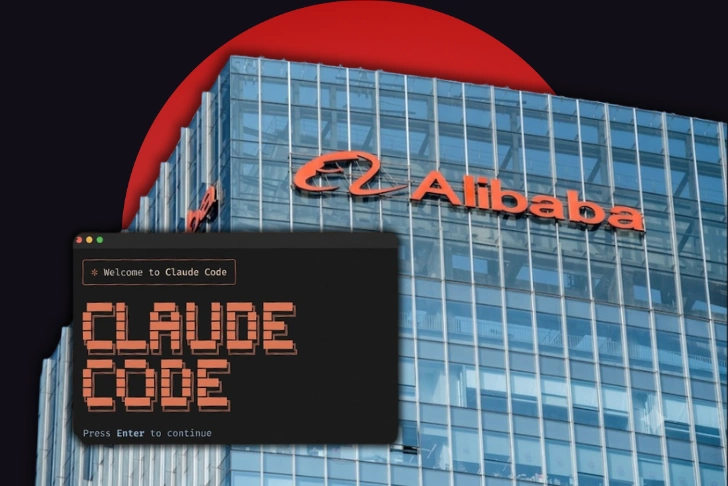
Alibaba has instructed its employees to stop using Anthropic’s Claude Code AI coding assistant at work. The move follows concerns about features in the tool that could identify China-linked users.
Deepening US-China AI Tensions
The Chinese tech giant’s decision comes amid a growing dispute with Anthropic. The US firm recently accused Alibaba of illicitly extracting capabilities from its Claude AI models through a technique known as distillation.
This technique involves training smaller models on outputs from more advanced ones. It reportedly helps accelerate China’s progress toward capabilities like Anthropic’s advanced Mythos Preview.
Shift to Domestic Tools Accelerates
Claude Code has gained popularity among Chinese developers despite access restrictions. However, recent reports highlighted mechanisms in the tool that inspect user environments, including timezones and proxies. These insert subtle markers into prompts sent to Anthropic servers.
An Anthropic employee described the feature as an experiment launched in March. Its goal was to curb account abuse by unauthorized resellers and prevent model distillation.
Sources familiar with Alibaba’s directive said employees must now switch to the company’s own coding platform, Qoder. The company and Anthropic have not publicly commented on the latest development.
Enforcing Geographic Restrictions
The ban underscores challenges in enforcing geographic restrictions. Individual users can mask their locations via US-based servers. Corporations, however, face higher legal and compliance risks.
This episode highlights the intense US-China race for AI supremacy. As American developers tighten controls on unauthorized access, Chinese firms are pivoting toward domestic and open-source alternatives.
These include models like DeepSeek, Alibaba’s Qwen, Moonshot, and Zhipu. Meanwhile, some Chinese AI offerings are gaining traction in the US market, raising concerns among American experts.
Alibaba’s action was first reported by Chinese media. It reflects broader efforts by Chinese tech companies to reduce reliance on foreign AI tools amid escalating tensions.
Impact on Emerging Tech Sectors
For Pakistan’s tech sector and businesses exploring AI adoption, the spat signals potential supply chain and tool availability shifts. Local developers may increasingly turn to open-source options as global restrictions tighten.
The incident also raises questions about data security and intellectual property in cross-border AI collaboration. As both nations invest heavily in the technology, such conflicts could shape future innovation pathways.
Industry observers expect more such measures. Companies worldwide are balancing innovation speed with security and sovereignty concerns in the fast-evolving AI landscape.