Transforming Education Summit +4 Calls for Renewed Global Action to Accelerate Progress towards SDG 4.

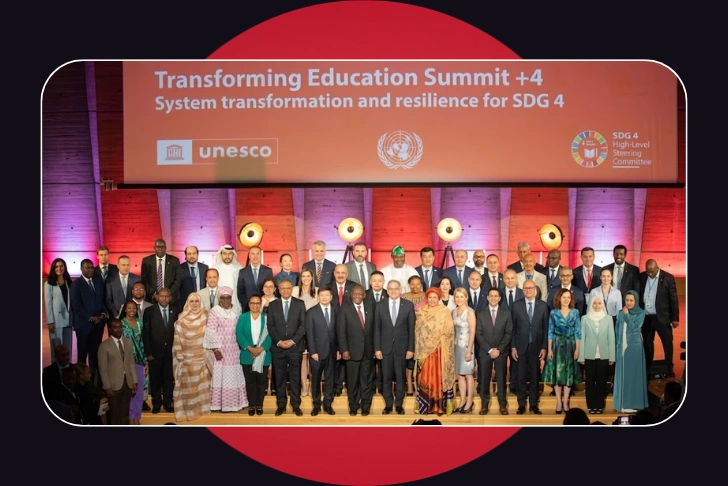
Global leaders, ministers of education, development partners, youth representatives, academia, and the private sector convened at the UNESCO Headquarters in Paris for the Transforming Education Summit +4 (TES+4). This high-level gathering marks a critical milestone midway between the landmark 2022 Transforming Education Summit and the 2030 deadline for achieving Sustainable Development Goal 4 (SDG 4) on inclusive and equitable quality education.
Convened by the United Nations Secretary-General and the Director-General of UNESCO during the SDG 4 High-Level Steering Committee meeting, the Summit reviewed progress made since 2022 while identifying urgent actions required to address persistent learning inequalities and strengthen the resilience of education systems worldwide.
Overcoming Unprecedented Global Pressures
Discussions underscored that education systems are facing unprecedented challenges arising from tight fiscal constraints, climate-induced disasters, protracted humanitarian crises, and the rapid advancement of emerging technologies, particularly artificial intelligence. Overcoming these hurdles requires renewed political commitment and innovative policy responses.
The Summit brought together high-profile participants, including:
- President Cyril Ramaphosa of South Africa
- United Nations Deputy Secretary-General Amina J. Mohammed
- Director-General of UNESCO Khaled El-Enany
- More than 25 Ministers of Education, alongside representatives from international financial institutions, civil society, and the private sector.
The event also featured Grammy-nominated artist Audrey Nuna, the singing voice behind Mira in the K-Pop Demon Hunters animated feature, highlighting the vital role of young, creative voices in advancing the global education agenda.
Tackling the Global Education Financing Crisis
A central theme of the discussions was the growing global education financing crisis. A major outcome of TES+4 was the launch of UNESCO’s new evidence and policy resources on education financing, including updated global investment data and a highly anticipated Technical Guide on Debt-for-Education Swaps.
This guidance aims to assist sovereign governments in converting their existing debt obligations into long-term domestic investments in education, helping vulnerable countries protect their schooling budgets amid growing fiscal pressures.
A Systemic Crisis: UNESCO highlighted that 113 countries—home to more than 6 billion people—currently spend more on servicing their national debt than on education. Meanwhile, low- and lower-middle-income countries continue to face an estimated US$97 billion annual financing gap for education.
Shaking the Future of Global Education
The Summit reaffirmed UNESCO’s leadership in shaping the future of education through strengthened international cooperation, resilient classroom systems, the responsible integration of artificial intelligence in schooling, and sustainable funding structures. Participants emphasized that accelerating progress towards SDG 4 will require collective, country-led reforms that ensure every learner has access to quality education, even in regions heavily affected by conflict, climate change, and economic volatility.
The strategic outcomes of TES+4 will help inform the global education agenda beyond 2030, serving as an essential roadmap ahead of the 2027 Global Education Meeting, the SDG 4 review at the High-Level Political Forum, and the 2027 SDG Summit.