Can AI Rescue Pakistan’s Education System
Listen7 min
Read aloud by your device’s built-in synthetic voice, not a recording. Needs a browser that can read aloud.
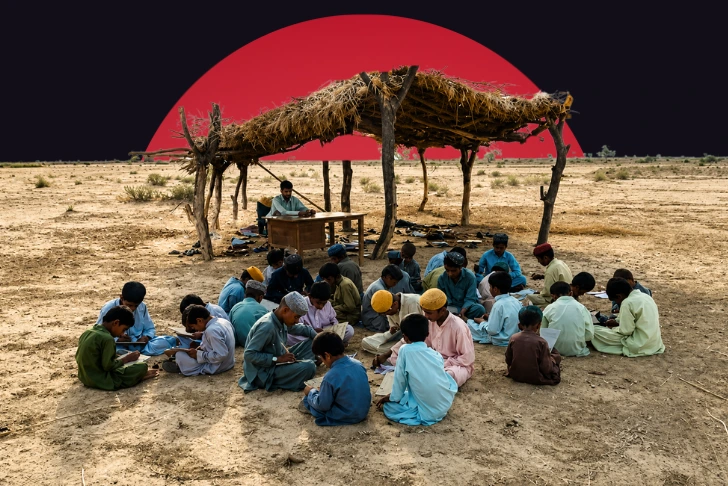
The Khyber Pakhtunkhwa (KP) government’s decision to launch Pakistan’s first public-sector virtual school system may become one of the country’s most important education reforms in years. By combining AI-assisted instruction with online classrooms and digitally linking hundreds of schools, the initiative seeks to widen access to quality education and reach children still outside the formal system.
At first glance, it may seem like another technology-led government project. In fact, it signals something more important: Pakistan’s education crisis can no longer be addressed through conventional solutions alone. Building more schools and hiring more teachers will remain essential, but the scale of the challenge now exceeds what traditional approaches can solve on their own. Artificial intelligence offers a way not to replace teachers, but to extend their reach and bring learning to children long excluded from the classroom.
The virtual school system was introduced to address one of Pakistan’s most persistent educational challenges: the shortage of qualified teachers, particularly in rural and underserved communities. Through technology-enabled classrooms, digital learning resources, and live online instruction, the programme delivers lessons in core subjects while placing particular emphasis on STEM education, robotics, and language development. Recognizing that internet connectivity remains limited in many remote areas, the initiative also incorporates radio-based education, enabling learning to reach communities where reliable internet access remains a challenge.
The urgency of such initiatives becomes clear when one looks at the scale of the problem in Khyber Pakhtunkhwa itself. An estimated 4.92 million children remain out of school, including 2.92 million girls and 1.99 million boys. Peshawar alone accounts for more than 519,000 children excluded from formal education.
According to the provincial education department, the majority of out-of-school children remain excluded from education because of deep-rooted systemic barriers rather than personal choice. Poverty, inadequate educational infrastructure, teacher shortages, long distances to schools, and entrenched socio-cultural norms continue to deny millions of children, particularly girls, the opportunity to learn. These structural challenges have persisted for decades, making it increasingly clear that incremental reforms alone will not be enough. Pakistan needs solutions that can be scaled rapidly without compromising the quality of education.
The challenge extends far beyond KP. Across Pakistan, an estimated 26.2 million children are out of school, roughly one-quarter to one-third of the country’s school-age population. That means between 26% and 36% of Pakistani children are being denied their right to education, making this one of the largest education crises in the world.
At the heart of the crisis lies poverty. It remains one of the principal drivers of school exclusion across Pakistan, preventing millions of children from accessing formal education because their families cannot afford the direct and indirect costs of schooling. For countless households, education is not merely a matter of aspiration but of economic survival.
This is why artificial intelligence deserves serious consideration in Pakistan’s education strategy. AI is not just another digital tool. It changes how education can be delivered. Unlike conventional classrooms, AI-powered platforms can personalise instruction according to each student’s needs. Lessons can be delivered in a child’s native language, while AI systems assess learning patterns, identify weaknesses and adjust the pace and style of teaching. Instead of forcing every child through the same curriculum at the same speed, AI allows education to adapt to the learner.
Perhaps AI’s greatest advantage is that it removes many of the barriers that have long limited access to education. Learning no longer has to take place inside a classroom or during fixed school hours. Children can study whenever their circumstances allow, whether they live in remote villages, work with their families or face other obstacles that prevent regular attendance. For millions of underserved children, flexibility may be the difference between receiving an education and receiving none at all.
The benefits of AI should not be limited to children who are out of school. Pakistan is also facing a severe learning crisis among those already enrolled. According to the World Bank and the Pakistan Institute of Education, 77% of Pakistani children aged 10 cannot read and understand a simple age-appropriate text. This alarming figure shows that enrolment alone does not guarantee learning. A child sitting in a classroom without acquiring basic literacy skills is still being failed by the system.
Here too, AI can become a powerful equaliser. Through personalised instruction, continuous assessment, instant feedback and targeted academic support, AI can help bridge learning gaps that conventional classrooms often struggle to address. Rather than replacing teachers, it can complement their work by allowing them to focus more on mentoring, critical thinking and student engagement while routine instruction and assessment become more adaptive and efficient.
Sceptics rightly point to Pakistan’s digital divide. Millions of children still lack smartphones, computers, reliable electricity or stable internet access. These concerns are valid, but they should not be treated as arguments against AI. Instead, they show where policy priorities must shift. The real obstacle is not the technology itself, but unequal access to it.
This is where governments, the private sector, universities, technology companies and international development partners must work together. Expanding affordable internet access, providing low-cost digital devices, investing in reliable electricity, training teachers to use AI in classrooms and developing high-quality educational content in local languages should become national priorities. The success of AI in education will depend less on sophisticated algorithms than on the political will to make these tools widely accessible.
Pakistan’s education crisis is fundamentally a crisis of scale. The country cannot build schools or train teachers quickly enough to meet the needs of every child through traditional methods alone. Artificial intelligence offers a way to accelerate progress by extending the reach of quality education to communities that have long been underserved. It is not a silver bullet, nor should it be treated as one. But if implemented responsibly and equitably, alongside continued investment in teachers and schools, AI could become one of the most transformative educational tools Pakistan has ever adopted.
The question is no longer whether artificial intelligence can improve education. Around the world, it already is. The real question is whether Pakistan will seize this opportunity to ensure that every child, regardless of income, geography or circumstance, has access to the quality education they deserve. The technology exists. The need is undeniable. What remains uncertain is whether we have the collective vision and political resolve to make that future a reality.