
President Zardari Reaffirms Pakistan’s Commitment To Economic Reforms
Listen3 min
Read aloud by your device’s built-in synthetic voice, not a recording. Needs a browser that can read aloud.
✧ GENERATE BRIEFING
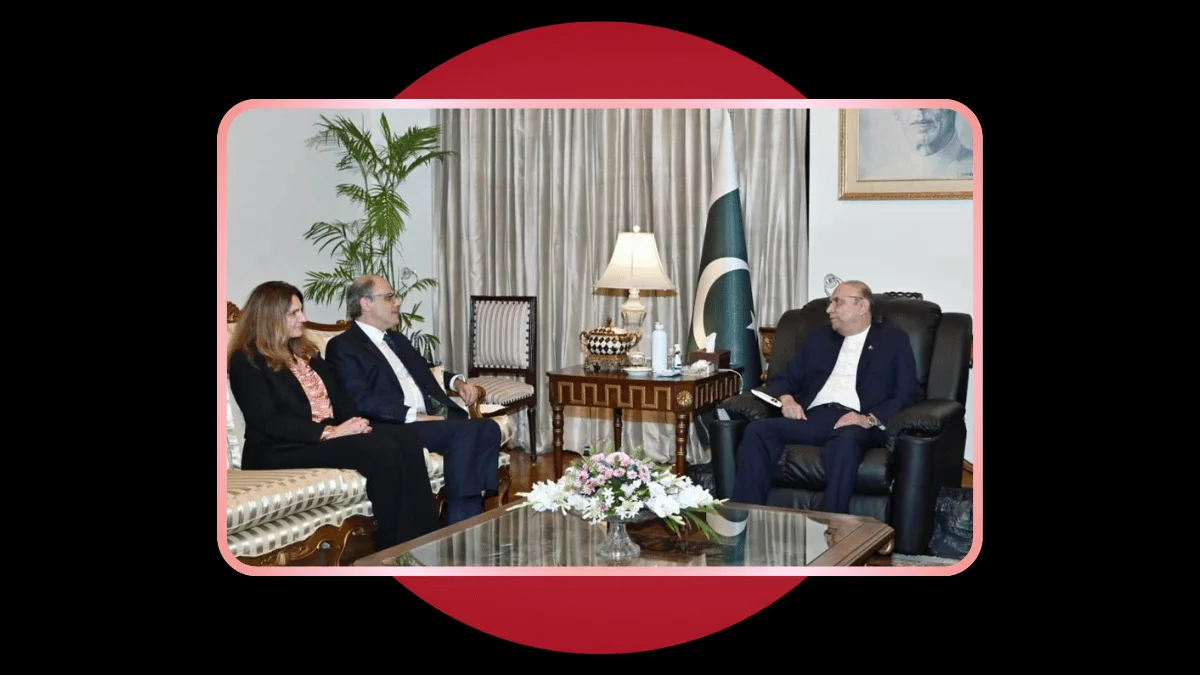
President Asif Ali Zardari met with an International Monetary Fund (IMF) delegation led by Jihad Azour, Director of the Middle East and Central Asia Department, at Aiwan-e-Sadr on October 20, 2026. The meeting followed the successful completion of staff-level agreements under the Extended Fund Facility (EFF) and the Resilience and Sustainability Facility (RSF), paving the way for a $1.21 billion tranche release pending IMF Executive Board approval. Key macroeconomic indicators, structural policy commitments, and meeting details include: Macroeconomic Expansion: President Zardari briefed the delegation that Pakistan’s nominal economy expanded to $452.1 billion in FY2025–26, with real GDP growth accelerating to 3.7% (up from 3.2% in FY25). Fiscal Consolidation & Primary Surplus: The national fiscal deficit contracted to 2.6% of GDP in FY26. Pakistan achieved its third consecutive annual primary budget surplus, reflecting tight expenditure controls and revenue mobilization efforts.
President Asif Ali Zardari has reaffirmed Pakistan’s commitment to fiscal sustainability, energy-sector reforms, privatisation and social protection, saying the country aims to maintain economic recovery while promoting inclusive and environmentally sustainable growth.
The president expressed these views during a meeting with Jihad Azour, Director of the International Monetary Fund’s Middle East and Central Asia Department, at Aiwan-e-Sadr on October 20. The IMF delegation also included Iva Petrova, the fund’s mission chief for Pakistan, and Mahir Binici, its resident representative in the country.
Pakistan’s Economy Reaches $452.1 Billion
According to the Press Information Department (PID), Zardari appreciated the IMF’s continued engagement with Pakistan and expressed confidence in the country’s progress under the Extended Fund Facility (EFF) and the Resilience and Sustainability Facility (RSF). The meeting followed the conclusion of the programmes’ fourth and third reviews, respectively, alongside a staff-level agreement.
During the meeting, Zardari said Pakistan’s economy had reached $452.1 billion in fiscal year 2026, while real gross domestic product (GDP) growth accelerated to 3.7%, compared with 3.2% in FY2025.
He also highlighted improvements in public finances, stating that the fiscal deficit had declined to 2.6% of GDP in FY2025-26. Pakistan recorded a primary surplus for the third consecutive year in FY2026, according to the presidential briefing.
These indicators featured in the government’s assessment of the country’s transition from economic stabilisation towards recovery. Sustaining that progress, however, will depend on continued implementation of reforms and the management of fiscal and external economic pressures.
Tax Administration and Public-Sector Reforms
The president emphasised the need to strengthen revenue mobilisation, improve tax administration and reform public-sector institutions.
He highlighted initiatives to expand tax documentation, digitise revenue collection and curb tax evasion. These measures form part of the government’s broader effort to improve public finances and strengthen the country’s capacity to meet its fiscal commitments.
Zardari also said political stakeholders and provincial governments were contributing to the implementation of reform targets.
IMF Stresses Continued Reform Efforts
Jihad Azour acknowledged Pakistan’s engagement with the IMF under the ongoing reform programme and emphasised the importance of maintaining reform momentum.
The discussions focused on macroeconomic stability, fiscal discipline and sustainable economic growth. The IMF’s engagement with Pakistan includes the EFF programme and the RSF facility, which supports reforms related to resilience and sustainability.
The completion of programme reviews and a staff-level agreement represent progress in the ongoing engagement, although continued implementation of agreed measures remains important.
Federal Minister for Finance and Revenue Muhammad Aurangzeb, Senator Sherry Rehman, Senator Saleem Mandviwalla, former federal minister Syed Naveed Qamar and the finance secretary also attended the meeting.
The president reiterated Pakistan’s commitment to economic reforms while underscoring the importance of peace amid the continuing conflict in the Middle East.